Our team is building a robot that moves around a competition arena and operates mechanisms to complete scoring tasks. I focus on the system that moves the robot, plus mechanisms to knock over targets and raise a flag.
CourseME 2110 · Creative Decisions and Design
My contributionDrivetrain design, fabrication & testing; two task mechanisms
Project stageIn progress · First prototype pictured
01 / Understand the challenge
One arena. Several ways to score.
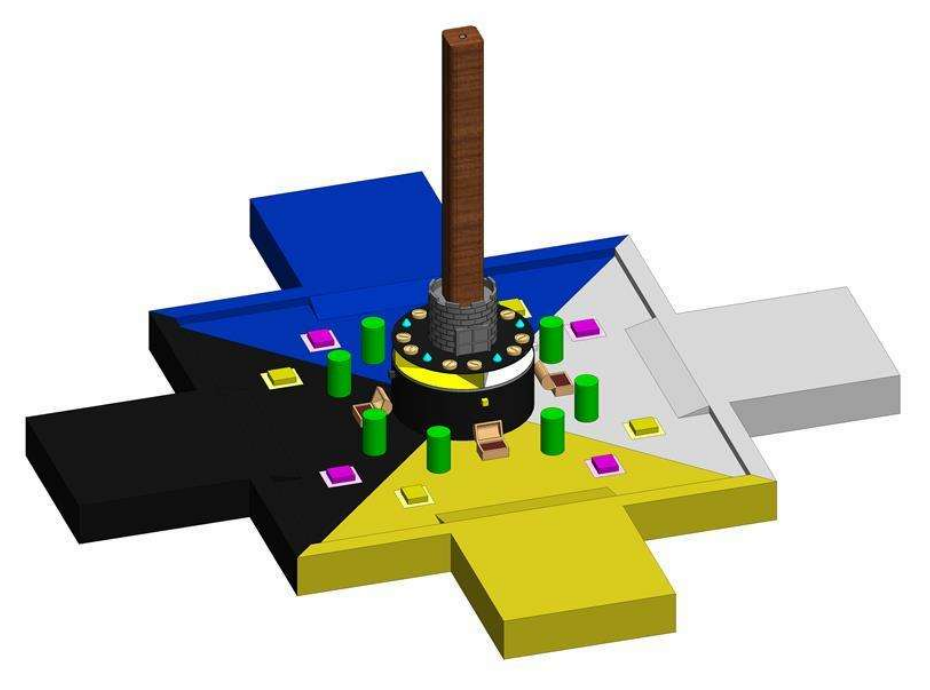
The Fall 2026 project uses a “Pirates of the Caribbean” theme. Teams build robots to compete in 40-second rounds on a shared arena. Each robot starts on an outer platform and enters a play area with targets, objects to collect, and a central structure with a flagpole.
The pirate names describe physical engineering tasks. “Mermaids” are targets to displace or topple. “Run up the Flag” means lifting a magnetic flag onto the central pole and keeping it attached until the round ends.
Competition arena from the course project brief, Figure 6 (page 9). The tall center pole is the flag-raising destination.
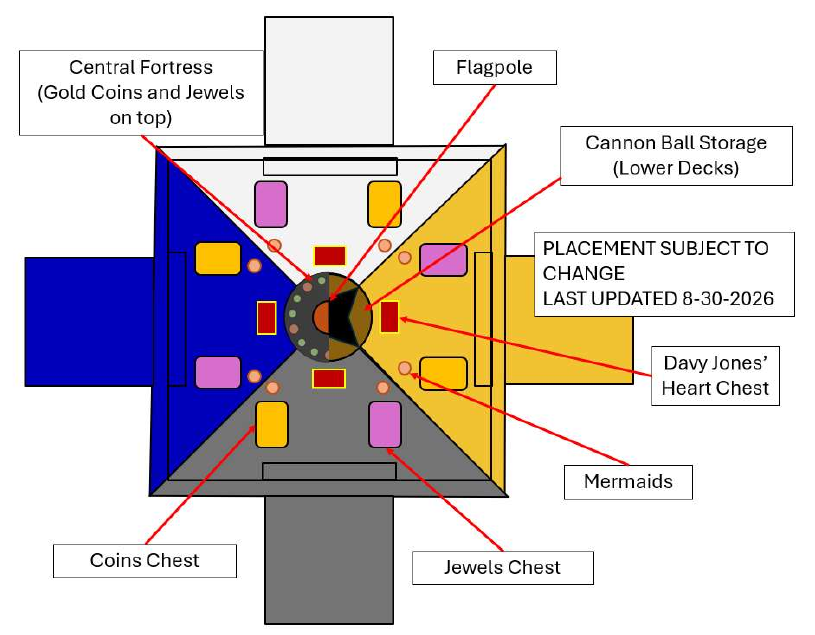
Labeled arena from Figure 1 (page 2). Open the image to read the original labels.
How to read the track
Outer platforms: where robots begin the round.
Colored sections: the team areas around the center.
Mermaid targets: obstacles positioned in the play area that can be displaced or knocked over for points.
Central flagpole: where the robot must place and secure its flag.
Other scoring tasks involve coins, jewels, cannonballs, and a chest. My work focuses on movement and the two tasks below.
02 / My engineering work
Move the robot. Reach the target. Operate the mechanism.
My contribution spans the drivetrain—the components that turn motor output into robot movement—and the mechanisms for two scoring tasks.
01
Drivetrain design and testing
Purpose: Move the robot through the arena and position it for the scoring tasks.
My work: I designed and tested the drivetrain, focusing on optimization and fabrication. Building and testing the physical system lets me evaluate how the design behaves before making further changes.
02
Knock over the mermaid targets
Purpose: Displace the mermaid-shaped targets from their starting positions. The rules award more points when a target is completely toppled or tilted at least 45 degrees.
My work: I focused on the mechanism for this task, alongside my drivetrain work. The robot must reach the target and make contact with it to score.
03
Raise and attach the flag
Purpose: Lift a flag to the central pole and attach it magnetically. Scoring depends on its final height, and the flag must stay attached until the round ends.
My work: I focused on the flag-raising task mechanism. This task connects robot positioning with the mechanical challenge of lifting and placing the flag.
03 / The first physical prototype
What we have built so far.
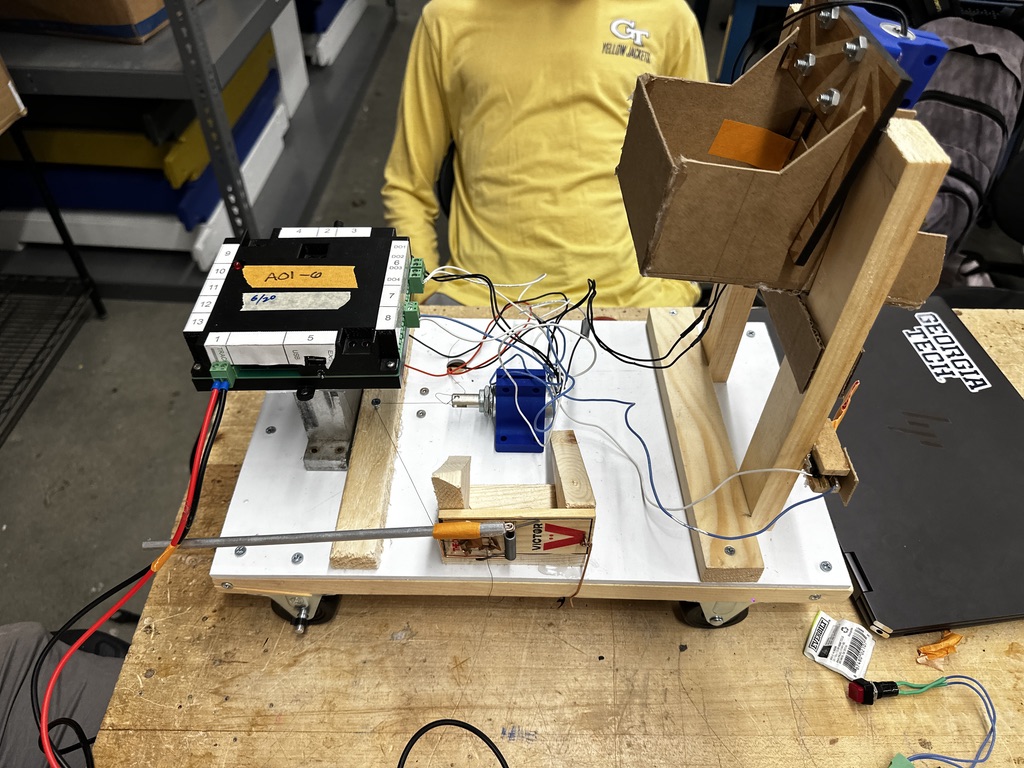
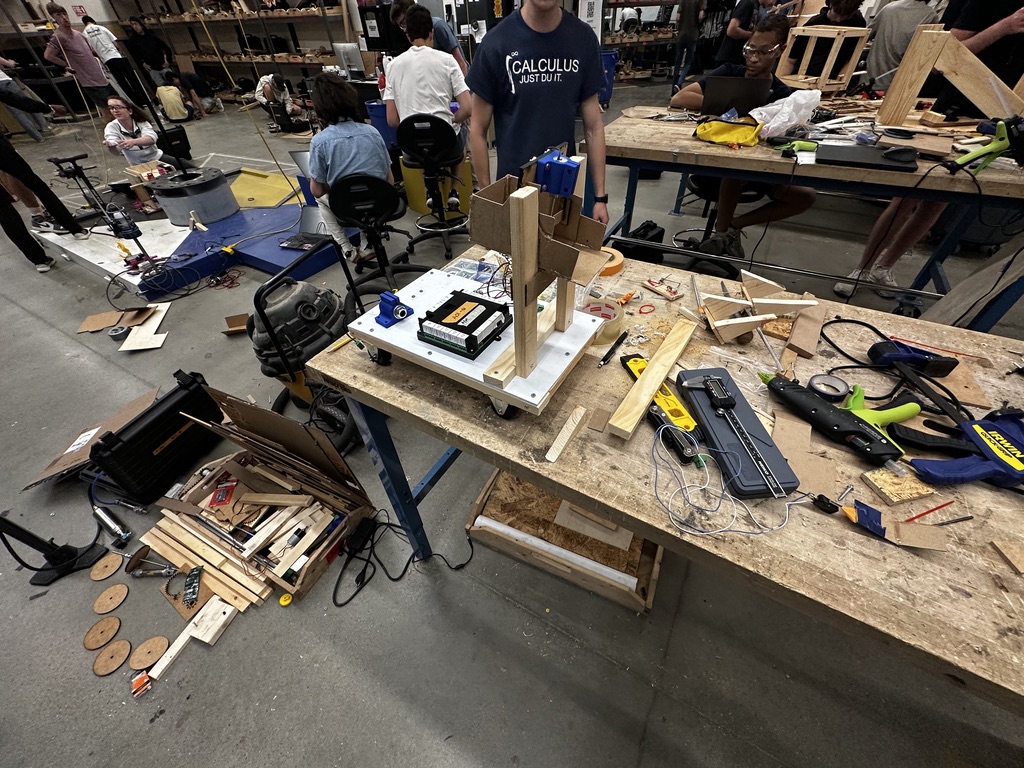
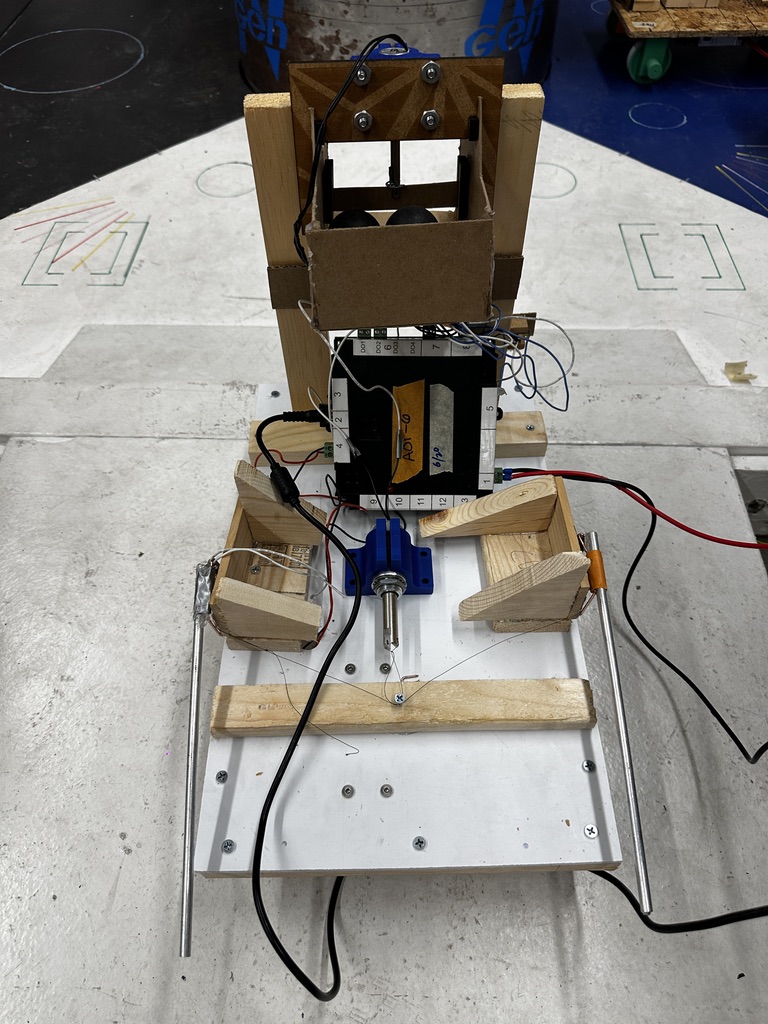
These photos show the team's first iteration during fabrication and assembly. They document an early build rather than the finished competition robot.
Side view: the base supports the controller, actuators, wiring, and upright structure as one assembly.
Workshop view: the first iteration during fabrication and integration.Overhead view: component placement and wiring on the chassis.
04 / Project status
Designing, testing, and refining.
The project is ongoing. My work so far includes drivetrain design and testing, fabrication, and development of the mermaid and flag task mechanisms. Measured drivetrain performance, task success rates, and competition results will be added as they are documented.