String Linear Density
Two-Method Metrology Comparison
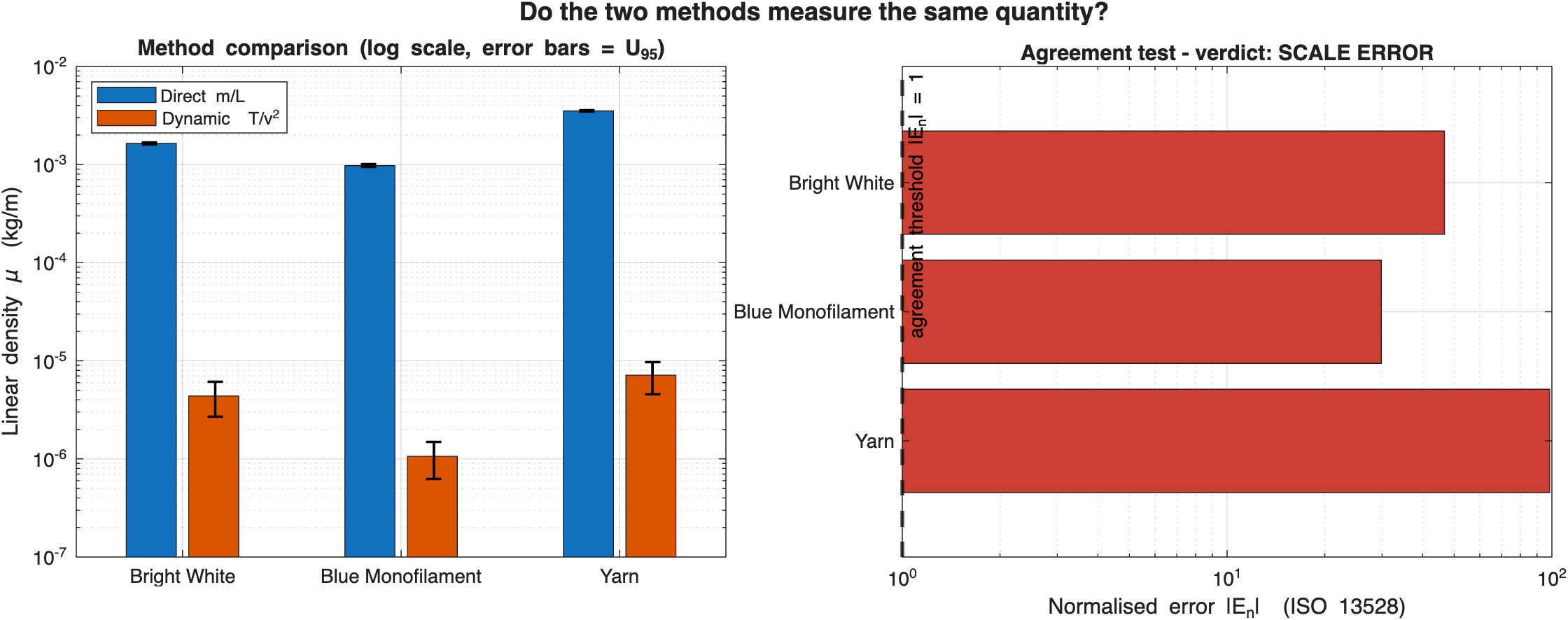
Two independent methods, one quantity, and a question of trust
Two ways to measure the mass per unit length (μ) of a string: weigh a known length directly, or drive it to resonance under known tension and back μ out of the wave speed. The question isn't whether the two numbers come out close. It's whether they agree once you account for how precisely each one was actually measured.
A percent difference isn't an answer, it's a way of not answering
My first version of this analysis computed a percent difference between the two methods, printed 99.7%, 99.9%, and 99.8% in a table, and moved on. Those three numbers are the actual result of the experiment. I had formatted them to look like a rounding error.
So I rebuilt it to say how wrong, and why — propagating measurement uncertainty through both methods and testing agreement against a standard statistic instead of eyeballing a gap.
Direct measurement vs. wave speed, each with propagated uncertainty
Direct: μ = m/L from one mass and one length measurement. Instrument uncertainty propagates by the GUM rule — relative uncertainties add in quadrature — giving a tight, defensible error bar from just two numbers.
Dynamic: T = μv² — tension against wave speed squared, slope through the origin gives μ. No free intercept, since zero tension can't produce wave motion. Uncertainty in v carries into the fit through a weighted regression, and I report whichever is larger, the propagated instrument error or the observed scatter, rather than let a tight-looking three-point fit understate itself.
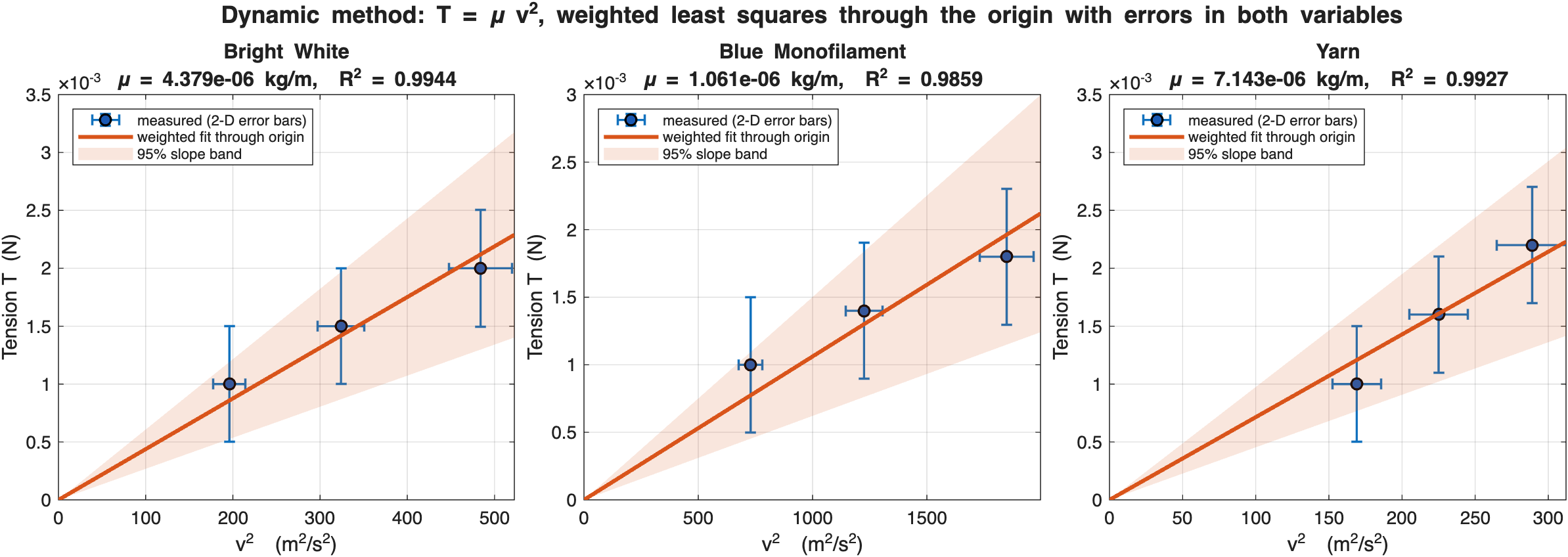
T vs. v² for each string — the weighted fit through the origin, with error bars on both axes. Every one of these fits scores R² above 0.98.
The normalized error test, not a percent gap
Percent difference can't say whether a gap matters. The ISO 13528 normalized error, |Eₙ| = |μₐ − μᵦ| / √(Uₐ² + Uᵦ²), can: a result of 1 or below means the two methods agree within their combined uncertainty. Above that, the gap is too large for measurement error to explain.
None of these are marginal. All three are an order of magnitude past the threshold where the two methods could be said to agree.
Every fit was internally consistent, and every fit was wrong
Every regression in the dynamic method scores R² above 0.98. The data lies beautifully on a straight line through the origin — it's perfectly consistent with itself, and it's still completely wrong.
Traced to the tension column, not the physics
Working backward from the wave-speed data, the tension values needed to make the numbers self-consistent are ordinary bench values — 0.3 to 1.8 N, or 30 to 180 grams hanging on a string. What's actually recorded is 0.1 to 0.2 gram-force, which wouldn't tension a string at all. The wave-speed measurements themselves are fine; the tension column is the problem.
An audit comparing the disagreement ratios across all three strings points to a scale error — roughly a common factor of 554 — rather than three unrelated mistakes. Multiplying the tension column by that factor brings two of the three strings into agreement, but not the third, so there's a per-string issue layered on top of the scale problem. That's a diagnosis, not a fix: I kept the original recorded values in the dataset rather than quietly correcting them.
What actually needs to happen: check the tension units against the original lab sheet — most likely a hanging mass recorded in kilograms but entered as newtons, or a decimal slip in transcription. Re-measure at least one string start to finish to settle it. Take five or six tension readings per string instead of three, since at three points there's only one degree of freedom and the intercept test has almost no power. And until then, treat the direct method as the reference — it depends on only two measurements, both internally consistent and physically sensible for this kind of string.